 (443) 247 0194
 925 NW 97TH AVE 103 MIAMI, FL 33172-2376, United States

May 4, 2026

Mental health CPT codes define how psychotherapy, psychiatric evaluation, crisis intervention, testing, and medication management services are reported for insurance reimbursement. These codes operate under the HIPAA-recognized Current Procedural Terminology system maintained by the American Medical Association.
In behavioral health claims processing, CPT selection affects reimbursement, authorization, denials, and audit risk. This page focuses on CPT selection logic, documentation thresholds, and payer denial drivers for behavioral health claims.
What Are CPT Codes in Mental Health?
CPT codes in mental health describe professional services delivered by psychiatrists, psychologists, licensed therapists, and behavioral health clinics. These codes report services: psychotherapy sessions, psychiatric diagnostic evaluations, crisis services, group therapy, family therapy, and psychological testing.
Mental health CPT coding is different from surgical specialties since many mental health treatments are more about time than procedures. To get paid, codes must match ICD-10-CM F-codes, prove that the therapy is medically necessary, and achieve the goals of the treatment plan.
How Are Mental Health CPT Codes Categorized?
Mental health CPT codes are organized under the broader CPT category structure and then subdivided by behavioral health service types.
CPT Category Structure
CPT codes are divided into three formal categories:
- Category I
Permanent procedure codes are used for standard clinical services. Most mental health CPT codes, including 90791 and 90834, belong to this category.
- Category II
Codes for measuring performance that are used to keep track of quality. There is no separate reimbursement for these codes.
- Category III
Temporary codes are given to new or experimental services that might subsequently change to Category I.
Category I CPT codes determine mental health billing workflow.
Service Classification in Behavioral Health
Mental health CPT codes are organized by service type in Category I:
- Psychiatric Diagnostic Evaluation
90791, 90792
- Psychotherapy
90832, 90834, 90837
- Psychotherapy Add-On Codes
90833 to 90838
- Interactive Complexity
90785
- Crisis Psychotherapy
90839, 90840
- Group and Family Therapy
90846, 90847, 90853
- Psychological Testing
96130 to 96139
This classification determines billing logic, documentation criteria, and payer standards for review.
How Does CPT Selection Logic Work in Mental Health?
The CPT selection process for mental health depends on time reported. Psychotherapy codes are chosen according to documented face-to-face time and midpoint rule enforcement rather than procedural completion. This framework differs from surgical CPT reporting, which is procedure-driven.
Duration-Driven Psychotherapy Coding
Psychotherapy CPT codes are selected based on documented session time:
- 90832; 16–37 minutes
- 90834; 38–52 minutes
- 90837; 53 minutes or more
The midpoint rule means the documented session time must exceed the halfway point of the CPT time range before the code can be reported.
CPT selection must meet the minimum time threshold. Rounded or unsupported time entries increase denial exposure.
Complexity-Based E/M Coding in Psychiatry
When medical evaluation or medication management occurs, CPT selection may follow evaluation and management logic.
Add-On Code Interdependency
Add-on codes cannot be billed on their own; they need an E/M primary service and separate treatment documentation.
What Documentation Is Required to Support Mental Health CPT Codes?
Structured clinical documentation that backs up code selection and shows medical necessity is needed for CPT reporting in mental health.
Required documents must include:
- Time documentation meeting CPT thresholds
- ICD-10-CM F-code diagnosis linkage
- Symptom severity documentation
- Functional impairment description
- Treatment plan alignment
- Measurable progress markers
- Authorization documentation when required by payer
When the record doesn’t show functional impairment, measurable progress markers, or a clear link between the treatments and the diagnosis, payers deny mental health CPT codes.
For psychological testing services, the documentation says how much time the provider and technician will spend, how the tests will be scored, how the results will be interpreted, and how supervision will work.
Example:
“Session from 2:00 to 2:50 PM (50 minutes). CBT treatment for panic symptoms. The patient says that the episodes happen less often. “Updated treatment plan.”
Insufficient documentation lacking meaningful clinical advancement elevates the probability of denial and intensifies audit scrutiny.
What Documentation Separation Is Required?
Split reporting requires:
- Separate medical assessment documentation for the E/M service
- Separate psychotherapy intervention documentation for the add-on CPT code
- Clear distinction between medication management and therapeutic intervention
Failure to separate components increases denial and audit risk.
When Are E/M Codes Used in Psychiatry?
Evaluation and Management (E/M) codes apply when medical decision-making or medication management occurs during the visit. Psychiatrists, PMHNPs, and qualified providers may report E/M services with psychotherapy add-on codes.
How Does Psychotherapy Add-On Coding Work with E/M?
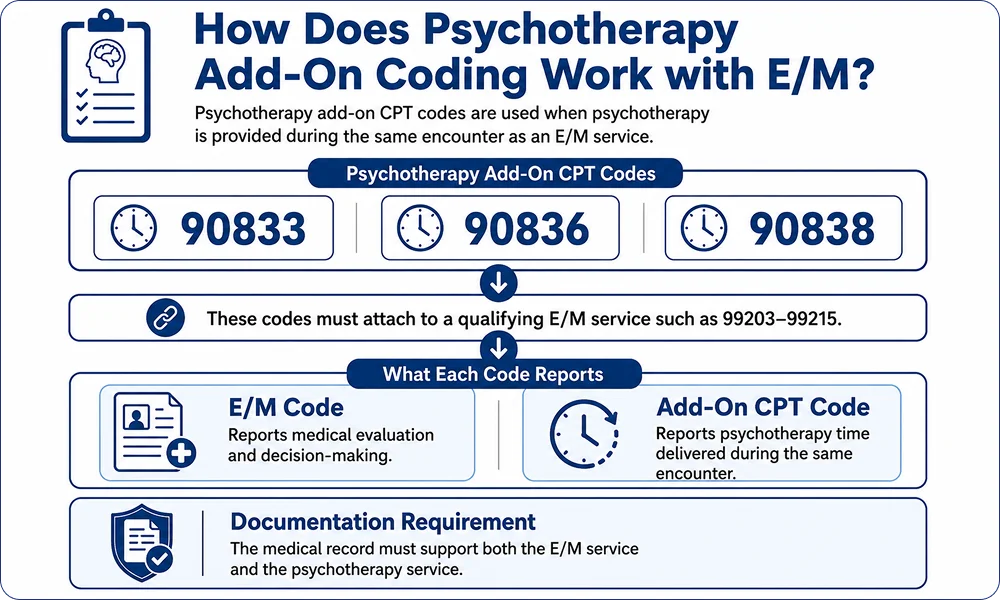
Psychotherapy add-on CPT codes include:
- 90833
- 90836
- 90838
These codes must attach to a qualifying E/M service such as 99203–99215. The E/M code reports medical evaluation and decision-making. The add-on CPT code reports psychotherapy time delivered during the same encounter.
The medical record must support both the E/M service and the psychotherapy service performed on the same date.
What Are the Most Common Mental Health CPT Code Denials?
Mental health CPT coding is subject to frequent payer review. Denials relate to time documentation, authorization requirements, evaluation overuse, and bundling errors.
Midpoint Rule and Under-Threshold Denials
Claims are denied when documented time does not meet required thresholds or when templated time entries lack specificity.
Prevention: Document start–stop time or total minutes and ensure the time meets the CPT threshold.
90791 Overuse and Re-Evaluation Limits
Psychiatric diagnostic evaluation codes need proof that the service is medically necessary. Repeated billing without any changes in the patient’s condition will lead to denial.
Many payers set limits on the number of sessions and require prior approval for psychotherapy CPT codes. The claim will be denied if the patient go beyond the visit limits without getting permission first.
Prevention: use psychotherapy CPT codes for regular follow-ups and get authorization before going beyond visit limitations.
90837 Audit Risk Exposure
90837 carries higher reimbursement. Using it excessively relative to what others do increases the chances of audits.
Prevention: Clearly document time and demonstrate that functional impairment and progress markers support medical necessity.
NCCI Bundling and Interactive Complexity Errors
Interactive complexity (90785) necessitates the documenting of communication obstacles, caregiver participation, or emotional intensity. Submitting it without justification leads to denial.
Prevention: State the 90785 trigger and show how it increased service complexity.
Psychological testing protocols must follow guidelines for supervision and how much time they can take.
Crisis Psychotherapy Escalation Errors
Crisis psychotherapy claims are rejected when the documentation fails to demonstrate immediate clinical urgency.
Crisis psychotherapy structure:
- 90839 for first 60 minutes of crisis intervention
- 90840 for each additional 30 minutes
Crisis CPT reporting necessitates evidence of imminent life-threatening risk, urgent clinical necessity, and same-day response.
Claims are denied when the record reflects routine distress, scheduled therapy, or ongoing symptom management rather than a true crisis presentation.
Core Mental Health / Psychotherapy CPT Codes
| CPT Code | Short Description |
|---|---|
| 90785 | Interactive complexity add-on |
| 90791 | Psychiatric diagnostic evaluation |
| 90792 | Psychiatric diagnostic evaluation with medical services |
| 90832 | Individual psychotherapy, 30 min |
| 90833 | Psychotherapy add-on with E/M, 30 min |
| 90834 | Individual psychotherapy, 45 min |
| 90836 | Psychotherapy add-on with E/M, 45 min |
| 90837 | Individual psychotherapy, 60 min |
| 90838 | Psychotherapy add-on with E/M, 60 min |
| 90839 | Crisis psychotherapy, first 60 min |
| 90840 | Crisis psychotherapy add-on, extra 30 min |
| 90845 | Psychoanalysis |
| 90846 | Family psychotherapy, patient not present |
| 90847 | Family psychotherapy, patient present |
| 90849 | Multiple-family group psychotherapy |
| 90853 | Group psychotherapy |
| 90863 | Pharmacologic management add-on |
| 90865 | Narcosynthesis psychiatric procedure |
| 90867 | TMS initial mapping and treatment |
| 90868 | TMS subsequent treatment session |
| 90869 | TMS motor threshold re-determination |
| 90870 | Electroconvulsive therapy / ECT |
| 90875 | Biofeedback with psychotherapy, 30 min |
| 90876 | Biofeedback with psychotherapy, 45 min |
| 90880 | Hypnotherapy |
| 90882 | Environmental intervention for psychiatric care |
| 90885 | Psychiatric record review |
| 90887 | Explanation to family/others |
| 90889 | Psychiatric report preparation |
| 90899 | Unlisted psychiatric service |
CMS notes that standalone psychotherapy codes include 90832, 90834, and 90837; psychotherapy with E/M uses E/M plus add-on codes 90833, 90836, and 90838. CMS also states 90839 is the crisis first-hour code and 90840 is the additional-time crisis add-on.
Psychological / Neuropsychological Testing CPT Codes
| CPT Code | Short Description |
|---|---|
| 96116 | Neurobehavioral status exam |
| 96121 | Neurobehavioral status exam add-on |
| 96130 | Psychological testing evaluation, first hour |
| 96131 | Psychological testing evaluation add-on |
| 96132 | Neuropsychological testing evaluation, first hour |
| 96133 | Neuropsychological testing evaluation add-on |
| 96136 | Test administration by professional, first 30 min |
| 96137 | Test administration by professional add-on |
| 96138 | Test administration by technician, first 30 min |
| 96139 | Test administration by technician add-on |
| 96146 | Automated psychological/neuropsychological testing |
CMS lists these testing families under commonly used mental-health-related HCPCS/CPT codes.
Screening, Assessment, and Health Behavior CPT Codes
| CPT Code | Short Description |
|---|---|
| 96110 | Developmental screening |
| 96127 | Brief emotional/behavioral assessment |
| 96156 | Health behavior assessment/reassessment |
| 96158 | Health behavior intervention, individual |
| 96159 | Health behavior intervention add-on |
| 96160 | Patient-focused health risk assessment |
| 96161 | Caregiver-focused health risk assessment |
| 96164 | Health behavior group intervention |
| 96165 | Group intervention add-on |
| 96167 | Family health behavior intervention, no patient |
| 96168 | Family intervention no-patient add-on |
| 96170 | Family health behavior intervention, with patient |
| 96171 | Family intervention with-patient add-on |
CMS says psychiatric treatment should be coded with psychiatric CPT codes 90791–90899, while health-and-behavior assessment/intervention codes are used when the service focuses on behavioral factors affecting physical health.
ABA / Adaptive Behavior CPT Codes
| CPT Code | Short Description |
|---|---|
| 97151 | Behavior identification assessment |
| 97152 | Supporting behavior assessment |
| 97153 | Adaptive behavior treatment by protocol |
| 97154 | Group adaptive behavior treatment |
| 97155 | Treatment with protocol modification |
| 97156 | Family adaptive behavior guidance |
| 97157 | Multiple-family adaptive behavior guidance |
| 97158 | Group treatment with protocol modification |
| 0362T | Severe behavior assessment, multi-technician |
| 0373T | Severe behavior treatment, multi-technician |
CMS and AMA list 97151–97158 as adaptive behavior service codes. ABA Coding Coalition also identifies 0362T and 0373T as Category III adaptive behavior codes used for severe destructive/maladaptive behavior cases.
Behavioral Health Integration / Collaborative Care CPT Codes
| CPT Code | Short Description |
|---|---|
| 99484 | General behavioral health integration |
| 99492 | Psychiatric collaborative care, initial month |
| 99493 | Psychiatric collaborative care, later month |
| 99494 | Psychiatric CoCM add-on time |
| 99483 | Cognitive assessment and care planning |
| 99446 | Interprofessional consult, 5–10 min |
| 99447 | Interprofessional consult, 11–20 min |
| 99448 | Interprofessional consult, 21–30 min |
| 99449 | Interprofessional consult, 31+ min |
| 99451 | Written/electronic interprofessional consult |
| 99452 | Treating provider consult prep/report |
AMA lists 99484, 99492, 99493, 99494, 99483, and interprofessional consultation codes in its behavioral health integration coding guide. CMS also explains that 99494 is an add-on to 99492 or 99493, and G2214 is a shorter Medicare CoCM option.
Preventive Counseling / Substance Use / Behavior Change CPT Codes
| CPT Code | Short Description |
|---|---|
| 99401 | Preventive counseling, individual, brief |
| 99402 | Preventive counseling, individual, moderate |
| 99403 | Preventive counseling, individual, longer |
| 99404 | Preventive counseling, individual, extended |
| 99406 | Tobacco cessation counseling, brief |
| 99407 | Tobacco cessation counseling, intensive |
| 99408 | Alcohol/substance screening and brief intervention |
| 99409 | Alcohol/substance intervention, longer |
| 99411 | Preventive counseling, group, 30 min |
| 99412 | Preventive counseling, group, 60 min |
AMA places these under counseling, risk-factor reduction, and behavioral-change interventions in behavioral health coding.
Psychiatry Medication Management / E/M CPT Codes
| CPT Code | Short Description |
|---|---|
| 99202 | New patient office E/M, straightforward |
| 99203 | New patient office E/M, low complexity |
| 99204 | New patient office E/M, moderate complexity |
| 99205 | New patient office E/M, high complexity |
| 99211 | Established patient minimal E/M |
| 99212 | Established patient E/M, straightforward |
| 99213 | Established patient E/M, low complexity |
| 99214 | Established patient E/M, moderate complexity |
| 99215 | Established patient E/M, high complexity |
Psychiatrists, PMHNPs, and other qualified medical providers often use E/M codes for medication management. CMS states that when E/M and psychotherapy are billed on the same date, the two services must be significant and separately identifiable, and psychotherapy time cannot be counted toward the E/M level.
Caregiver / Behavior Management CPT Codes
| CPT Code | Short Description |
|---|---|
| 96202 | Multiple-family behavior training |
| 96203 | Multiple-family behavior training add-on |
| 97550 | Caregiver training, first 30 min |
| 97551 | Caregiver training add-on |
| 97552 | Group caregiver training |
CMS lists these caregiver and behavior-management training codes in its commonly used mental-health-related code table.
Common Mental Health HCPCS Codes — Not CPT, But Often Used
| Code | Short Description |
|---|---|
| G0017 | Crisis psychotherapy, applicable non-office site |
| G0018 | Crisis psychotherapy add-on, applicable non-office site |
| G0136 | Physical activity/nutrition assessment |
| G2213 | ED medication initiation for OUD |
| G2214 | Psychiatric CoCM, first 30 min |
| G0544 | Post-discharge behavioral health follow-up calls |
| G0546–G0550 | Interprofessional assessment/management |
| G0551 | Interprofessional referral service |
| G0552 | Digital mental health device supply/onboarding |
| G0553 | DMHT monthly treatment management |
| G0554 | DMHT monthly management add-on |
| G0560 | Safety planning intervention |
How Does Telehealth Affect Mental Health CPT Coding?
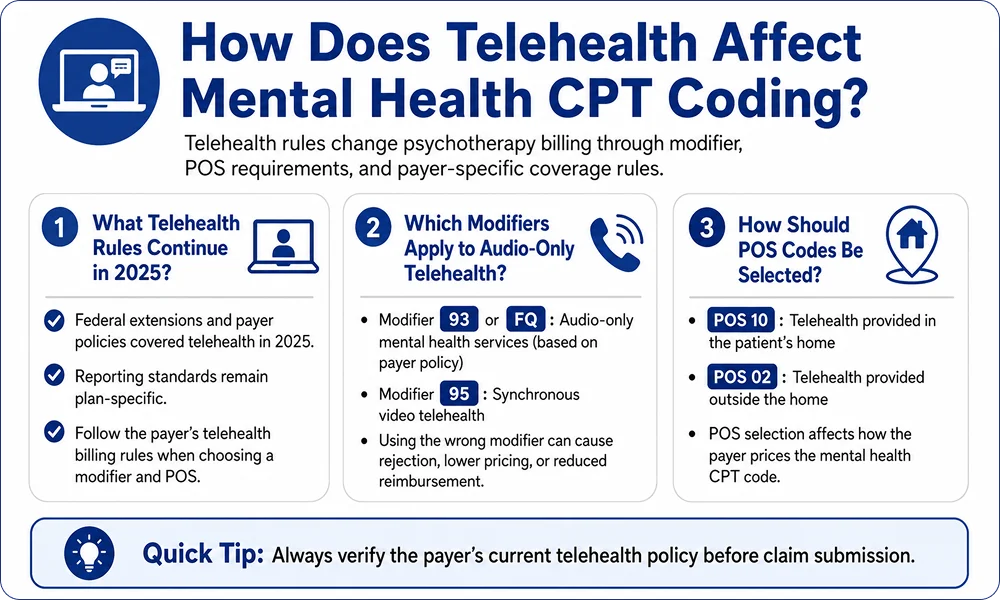
Telehealth rules change psychotherapy billing through modifier, POS requirements, and payer-specific coverage rules.
What Telehealth Rules Continue in 2025 for Mental Health CPT Codes?
Federal extensions and payer policies covered telehealth in 2025. The standards for reporting remain plan-specific, so the payer’s telehealth billing regulations are followed when choosing a modifier and POS.
Which Modifiers Apply to Audio-Only Telehealth?
Audio-only mental health services use modifier 93 or FQ based on payer policy. The payer uses modifier 95 for synchronous video telehealth. Choosing the wrong modifier results in rejection, a lower price, or decreased reimbursement.
How Should POS Codes Be Selected for Telehealth?
POS selection affects how the payer prices the mental health CPT code:
- POS 10 reports telehealth provided in the patient’s home
- POS 02 reports telehealth provided outside the home setting
Incorrect POS selection affects payment calculation.
How Do Reimbursement Rates Vary by Provider Type?
Reimbursement for identical CPT codes varies by credential and contract structure.
Allowed amounts differ among:
- Psychiatrist (MD/DO)
- Psychiatric Mental Health Nurse Practitioner (PMHNP)
- Psychologist (PsyD/PhD)
- Licensed Professional Counselor (LPC)
- Licensed Clinical Social Worker (LCSW)
Commercial insurers and Medicaid programs assign credential-specific fee schedules to CPT codes. The CPT code remains the same, but the contracted rate changes according to licensure type and network participation status.
Provider-type reimbursement differences support contract evaluation and forecasting of the revenue.
Conclusion
Mental health CPT coding connects clinical documentation directly to reimbursement. For accurate billing, you need to know the right service classification, time limits, medical necessity, and restrictions that are specific to each payer, such as telehealth modifiers and POS selection. Mistakes in reporting time, paperwork, using add-ons, or getting permission sometimes lead to denials and audits. When code selection, documentation, and payer requirements align, the behavioral health claims process runs correctly, and reimbursement risk decreases.
FAQs
Mental Health CPT Code Basics
What are mental health CPT codes?
Mental health CPT codes report psychotherapy, psychiatric evaluation, testing, and behavioral health services for reimbursement.
How are psychotherapy CPT codes selected?
Psychotherapy CPT codes are selected according to documented face-to-face session time thresholds.
What is the midpoint rule in mental health billing?
The midpoint rule requires session time to pass the halfway point of the CPT time range before billing.
Which CPT codes are commonly used for psychotherapy sessions?
90832, 90834, and 90837 are the most commonly reported outpatient psychotherapy CPT codes.
Documentation and Billing Compliance
What documentation supports mental health CPT codes?
Documentation must support time, medical necessity, diagnosis linkage, treatment goals, and clinical progress.
Why do payers deny mental health CPT codes?
Denials commonly occur due to insufficient documentation, authorization issues, modifier errors, and time mismatches.
When are psychotherapy add-on CPT codes used?
Psychotherapy add-on codes apply when psychotherapy is performed with a qualifying E/M service.
Why is 90837 considered high audit risk?
90837 receives higher reimbursement and triggers audits when documentation lacks medical necessity support.
Telehealth and Reimbursement Rules
Which modifiers apply to telehealth psychotherapy claims?
Modifier 95, 93, or FQ may apply depending on video or audio-only payer requirements.
Which POS codes are used for telehealth mental health billing?
POS 10 applies to patient-home telehealth, while POS 02 applies outside the home setting.
Do all provider types receive the same reimbursement for CPT codes?
Reimbursement varies by provider credential, payer contract, and network participation status.
How do telehealth billing errors affect reimbursement?
Incorrect modifiers or POS codes can cause claim rejection, underpayment, or delayed processing.

 Email
Email Time
Time


